I Actually Have a Job
I know it’s hard to believe, but in between my days I spend having fashion shows with my neighbors, and the ones I spend traveling all day just to get to a big city so I can taste a nice cheesy, greasy slice of pizza (literally typing this makes my mouth water, I miss cheese so much) I’ve got a job doing real people work (take that lazy millennial stereotype), teaching physics at the high school here, mostly teaching eighth graders, but also a little bit of eleventh. And if I’ve learned anything from the past few weeks, it’s that all my old high school teachers deserve a lot more respect than they get (idk if any of y’all are reading this, love you guys), cus this shiz ain’t easy.
To walk through a typical day-in-the-life, I usually get up at 5:30 to make it to school starting at 7:00. There all the students sing the national anthem at 6:45, with backs straight and hands by their sides, but it’s not expected for us to be there, and the anthem is long. So unnecessarily long, I don’t understand. There’s a refrain that they sing twice between any two verses, meaning you sing the same four lines six times. The whole thing’s like 5 minutes, but it feel like a literal lifetime, and I guarantee if I write “Na memoria de África e do mundo” in here, any Moz volunteers reading this will curse me for getting the thing stuck in their head (haha, suckers).
Also though, if any government officials are reading this, your anthem is a masterpiece, and your country’s beautiful. Please don’t deport me.
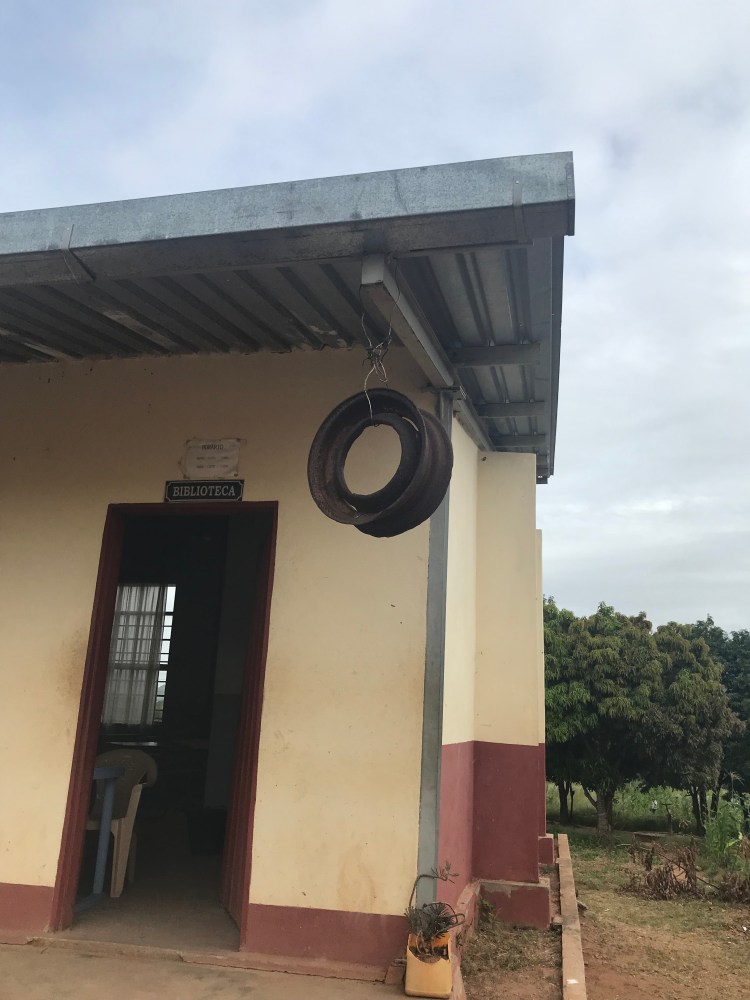
Either way, I roll up right after that to hear the morning bell, which is probably my favorite part about this place. Somebody just took an old rusty car wheel, tied it up from a rafter with some loose wire, and then they bang it with a piece of rebar at the beginning and end of every period. People always talk about German ingenuity and how smart they are for making good cars, but I think Mozambican ingenuity to look at the same car wheel and say “I could hit that with a stick and it’d make a lot of noise” deserves a bit of credit too.
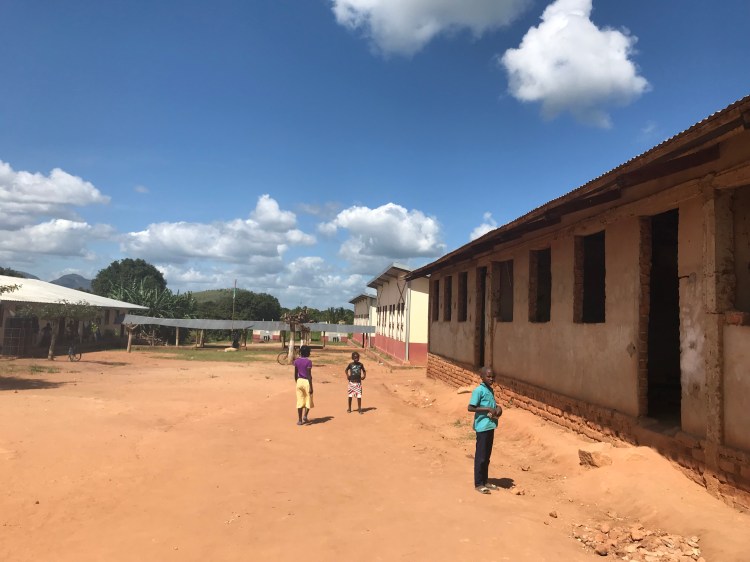
Another thing I think is so funny that Mozambique does, is that teachers are generally expected to wear batas, or lab coats, to make them feel distinguished I assume. So for the first couple of weeks, I felt kinda like a proper mad scientist, walking down the covered walkway with a billowing lab coat, chalk stains on my hands, probably some charcoal stains too I forgot to wipe off from cooking, speaking in a funny accent, probably looking super disheveled since I don’t have a mirror in my house and haven’t looked at my face in weeks. As time went on though, I realized I was one of maybe three teachers who actually used their batas. We’re in the middle of nowhere, so I get the sense teachers here think batas are more of a high-falootin, big city, southerner thing for the fancy pants down in Maputo to use. Also it’s way too hot for that. Bata or no bata, when the bell rings, since in Mozambique teachers move from room to room instead of students like in America, I stroll down the walkway to the next classroom, and all the students who were running around and making noise outside see you and get this super scared look on their faces since they know they’re meant to be in the classroom before I arrive, so they wrangle their friends and sprint to class to squeeze in before you walk in the door. From there there’s a really weird back and forth where you say (in Portuguese of course) “Good morning”, and they respond “Good morning Mr. Teacher”, “How’re y’all”, “We’re doing well, thanks be to God.” Which is a normal Mozambican response to that question, it’s not a super big deal what they’re saying, it’s more just weird having 40 kids shouting their emotional wellbeing at you in unison at 7 AM.
Another big difference between the American system of education, and the Mozambican system, is that in the US, you’re expected as a student to focus on 6 or 7 classes at once, and in order to cover everything, especially in science, you might end up, doing biology one year, chemistry another, and physics another, instead of taking them all at once. Here’s really different though, instead, they’re taking 12 or 14 or so courses a year, and every student just takes a small bitesize bit of Physics and Geography and English and everything else each year, for at least 8th through 10th grades, until 11th where they are meant to pick a track they want to pursue, be it sciences, arts, or humanities. In some ways that’s better. It gives students who drop out (and a lot of kids drop out) a well-rounded, albeit shallow, education in the years they do study. It also gives students a better idea of what subjects are like before picking a track later on in school, which is especially important here, since education has to be much more career driven than in the states, since an extremely small percentage of these students will go on to higher-education. The problem is it makes my job so much harder. Eighth grade kids don’t exactly have great memories, and only teaching students twice a week for 45 minutes gives them so little chance for retention. This system also means I’m competing with 13 or so other teachers for their time outside of school, and their energy in school. I probably get about 20% participation in homework, and the last quiz I gave I saw between 11 and 30 percent pass-rates for my students, and it was such an easy quiz. From what I hear though, that’s super normal here in Mozambique, even with local teachers speaking fluent Mozambican Portuguese, which is really disconcerting. The children here just don’t place a priority on high school education. Most know they’re going to work on farms after school, so except for their agriculture class, school here is seen as a bit of a waste of time, especially for parents who could otherwise be putting their children to work. This is even more the case since before 2013, my town didn’t have a secondary school, so students either went to one of the towns an hour away by car, or, much more likely, they stayed in town and worked, so since the school’s so new, any economic payoff a high school brings to a community hasn’t been felt by my town yet.
This turned into a bit of a downer post really fast, so here’s some good news, I’m getting the hang of it. It’s not easy teaching kids in this environment, but I’m starting to realize what sorts of things the children here respond to, they’re starting to understand my funny Portuguese accent, and the summer break slump is starting to wear off. I can’t imagine all 200-odd students of mine are going to end up winning Nobel Prizes in Physics, but there are at least few students in each class who are engaged and participate and make my life a lot easier, and one thing teaching teaches you real quick is to pick your battles. Some of my kids will drop out, some are going to fail, and a lot of them won’t care that it happened, but as they say here: Fazer o que? What can you do? Being proud of the kids that are getting it is all you can really ask for as a teacher.
 Richard Newsome - Peace Corps Mozambique
Great post, Richard! Love the school bell and the batas! I can just picture you! Maybe wearing a lab coat will gain me respect with my students. Gonna have to try that one! You have definitely learned the teacher mantra: Pick your battles. I hang on your every post, so keep ‘em coming! ❤️❤️
On Sun, Mar 8, 2020 at 6:13 PM Richard Newsome – Peace Corps Mozambique wrote:
> Richard Newsome posted: ” I Actually Have a Job I know it’s hard to > believe, but in between my days I spend having fashion shows with my > neighbors, and the ones I spend traveling all day just to get to a big city > so I can taste a nice cheesy, greasy slice of pizza (literally” >
LikeLike